The survivor mentality in Israeli organizational behaviour

For many reasons which are beyond the scope of this post, Israel and Israelis tend to have a survivor mind set which manifests itself in various domains such as internal politics, policy making and external affairs.

In this post, I will relate to the ways that the survivor mentality manifests itself in organizational behaviour, which is the domain of this blog.

Since there is a lot of deviation within any given population vis a vis specific behaviours, not every Israeli or Israeli organization will display these characteristics.

However I am dealing here with generalizations which are frequent enough to merit mention.

  • Emotional (life is a struggle)
  • Insider-outsider dynamic,or us or against us (friend or enemy?)
  • Paranoid about other’s hidden agendas (can you be trusted?)
  • Fast and responsive (matter of life and death)
  • Lots of argument about minute points; trees are as important as forests; not expedient (it is all about principle, not priority)
  • High level of involvement and commitment (it’s a war)
  • Very pragmatic and action orienteddo anything that works; hands on (shoot, don’t talk)
  • Extremely adverse to planning, preference to improvisation (hush hush about intentions)
  • Points of agreement constantly re-opened and negotiated (win, not win win)
  • Entertainment of parallel strategies all the time; not consistent (one upsmanship)
  • Speed as strategy ; build first and scale later, sloppy (slow and steady looses)
  • Challenge authority constantly but highly loyal in the crunch (commando)

So, what are the keys to being effective when you work with Israelis? The answer is a post in and of itself so I will leave you with 5 tips in the meantime.

  1. Talking on the phone is more effective than email.
  2. Be strong and negotiate all the time.
  3. Avoid expediency which is seen as a near fatal weakness.
  4. Don’t try to buy performance (Your bonus depends on this.)
  5. Discuss underlying trust issues openly. Israel ain’t Japan and the more open you are, the better.

This post is dedicated to my 4th grand daughter Rona, a 5th generation Israeli, born at 9 am this morning after a prolonged 8 minute labour! Speed as strategy.


rona

Share Button

Ambiguity, anxiety and changing-the role of the consultant

Organizational changing involves periods of ambiguity, during which it may not be clear what needs to be done and/or how to implement the changing.

When consultants are brought in, they often bring along process, trust-enhancement between divergent functions, and tools for bottom up involvement. Sometimes they work tailor made, and too often they use pre-packaged crappy tools with apparent effectiveness only.

In my consulting experience, I have found that I have created the most value for my clients by focusing on their basic assumptions about the ambiguity and the anxiety encountered in the changing process.

Here are several issues that my clients and I discuss. Introspecting working through these issues, they have reported a feeling of more competence in dealing with changing.

  • Which parameters are ambiguous? Which are not? Do we need a reality check?
  • What threat does the ambiguity create for me as a leader? What is my knee jerk reaction to ambiguity and anxiety? How effective has this been?
  • How does my anxiety about the ambiguity impact my assumptions about what is expected from me as well as what I expect from others?
  • How much tolerance for ambiguity is needed? How much is expected from me? How do I bridge the gap?

Here are five examples of how leaders have benefited from these discussions.

  • Ed’s level of anxiety is very low. And he has a huge tolerance for prolonged ambiguity. Often his troops believe he is lost, albeit that this is not the case at all.
  • Smadar is very practical and fast moving. She has little tolerance for “too much definition”. At first, she saw her style as very adaptive to changing but ex post facto, lots of change she has led have failed.
  • Vlad assumed that ambiguity needs to be as short as possible and anxiety can be mitigated by appearing to be strong. He has often been pushed aside by senior management during complex changes.
  • Ngai Lam’s belief is that a leader needs to protect her team from the unknown. She is very much respected by local employees but her remote staff believes she lacks the credibility to manage change.

OD’s major value is not extricating leadership from the unknown. The bang for the buck from OD is exploring with clients the parameters of the unknown and its implication on anxiety and leadership.

Share Button

Excellent!”

See http://www.blog.gr2010.com/what-makes-od-projects-easy/

Share Button

Case study – diverse patterns of communication under duress

Mohammed is a 2nd generation American whose family comes from Egypt. He heads the Middle East and Asia Sales for a Dutch-French conglomerate.

Mohammed has convened a meeting of his staff in Cyprus and has just conveyed bad news…..there is an 30% drop in revenue in 2015, and this will have massive impact on the region. Using a lot of emotion by slightly raising his voice, Mohammed asked all his managers to provide input to “make this problem go away”.

Hans, a German who heads sales in Indonesia, gave a very, very detailed blow by blow description of what was causing delay in revenue, product by product and client by client.   Mohammed, never known for his patience, told Hans to “focus on the woods and not the trees.”

Anat, an Israeli, (Israel, Cyprus, Turkey Region) argued that the way corporate recognizes revenue “makes no sense”. “Anat”, Mohammed  said, “I am also a Middle Easterner, but sometimes bargaining and positioning need to end”.

Watanabe, a Japanese managing Japan and Korea, sat and was silent. Mohammed told Watanabe that “silence is unacceptable”. Watanabe looked at him in shock. “I am thinking, Mohammed-san”. Do you want me to act with haste on such a serious issue”?

John  the American finance guru of the group suggested that no one go home before there is a detailed plan.

Mohammed pondered how to get all his team on the same page. Anat said “let’s start doing something”; Wantanabe was astonished.

Share Button

Driving cultural change after a merger-acquisition-updated

Following a merger or acquisition, leadership often has wet dreams about leveraging the merger/acquisition to maintain the best cultural components of both company via the forging of a new culture, enhanced by the stronger points of each component.

Yet, there is no such thing as creating a new culture in a merger, based on the best of both companies. Following an acquisition or merger, there is an inevitable Darwinist struggle between weaker and stronger cultures.

In this short post, i shall relate to driving a culture change in a post-merger/acquisition environment.

One culture (generally the acquiring company) asserts its culture on the other and dominates it. There is very little that can be done to prevent this, although the degree subtlety may appear different. I am not even sure that this Darwinism is bad, because companies need one dominant culture  to enable integration.

Over time, the acquired company’s culture may have some minor impact, but this will be in the context of the dominant culture.

There are three areas of focus which can create some cultural change in the year or so after merger/acquisition period.

1 The acquiring company will need to focus on the creation of scalability in order to get value from the acquisition. This need can drive massive change.

        2. The acquiring company will need to create a loyal power structure in the        acquired      company,which does not try to preserve autonomy.

2 The acquired company needs to go thru a period of mourning, to accept the new regime and to eventually join the acquiring company as individuals, not as a group.

Final comment:

Beyond the consultants role in enabling,  planning, execution and monitoring of mergers, a consultant would be wise to see his/her role as a midwife, not trying to fight some of the natural course of post merger events.

This having been said, there is a lucrative  market for pre-packaged crap (protocols)  that merge 2 or 3 cultures into one in a few easy steps.

Share Button

Communication in Asia and America-selected challenges

Although I am Middle East based OD consultant, I do lot of my work in Asia and the US.

The goal of this post is to compare the challenges I face communicating in the different environments.

Asia:-

Although today at the ripe old age of 66, I am very proficient in communicating with various populations in Asia, this proficiency was not easily acquired. Here are some brief highlights of the major communication lessons I have learnt.

  • Khun Som from Bangkok taught me just how much content can be communicated by evasiveness.
  • Mitsumi from Osaka taught me that in some instances, it takes years to formulate an answer and in the meantime, it is best to be silent.
  • Emma from Malaysia and Felipe from the Philippines have taught me that it is far better not to talk about certain things…so that communication can continue. 
  • Hsiao from Shanghai explained to me how `lying “can be very truthful. 
  • Sivan from Tel Aiv  taught me that when she stops arguing with me, she no longer cares.

My Asian clients always understood how different I am and never tried to convert me. We almost thrive on our difficulty to communicate!

America:-

  • It is possible to do business without a deep personal relationship using a contract used to hedge lack of initial trust. This setup enables expediency of communication. And it is critical to be expedient so as not to waste time. Expediency is an acquired skill for the non westerner.
  • The emphasis of expediency (which enables speed and a competitive edge) leads to view conflicts as something to be solved.
  • An American generally will expect the other side to adapt him/her self because there is one right way of communicating, our way. Once people “develop” and transcend hang ups, we can communicate, our way.

My background and values are somewhat more western than eastern, and I feel the western style of communication comes is more “natural” for me.

However, I feel more comfortable communicating in Asia because I feel that there is an enhanced awareness of the acutely diverse assumptions about communication, and less attempt to impose one style.

Share Button

Watching the refugees in Budapest

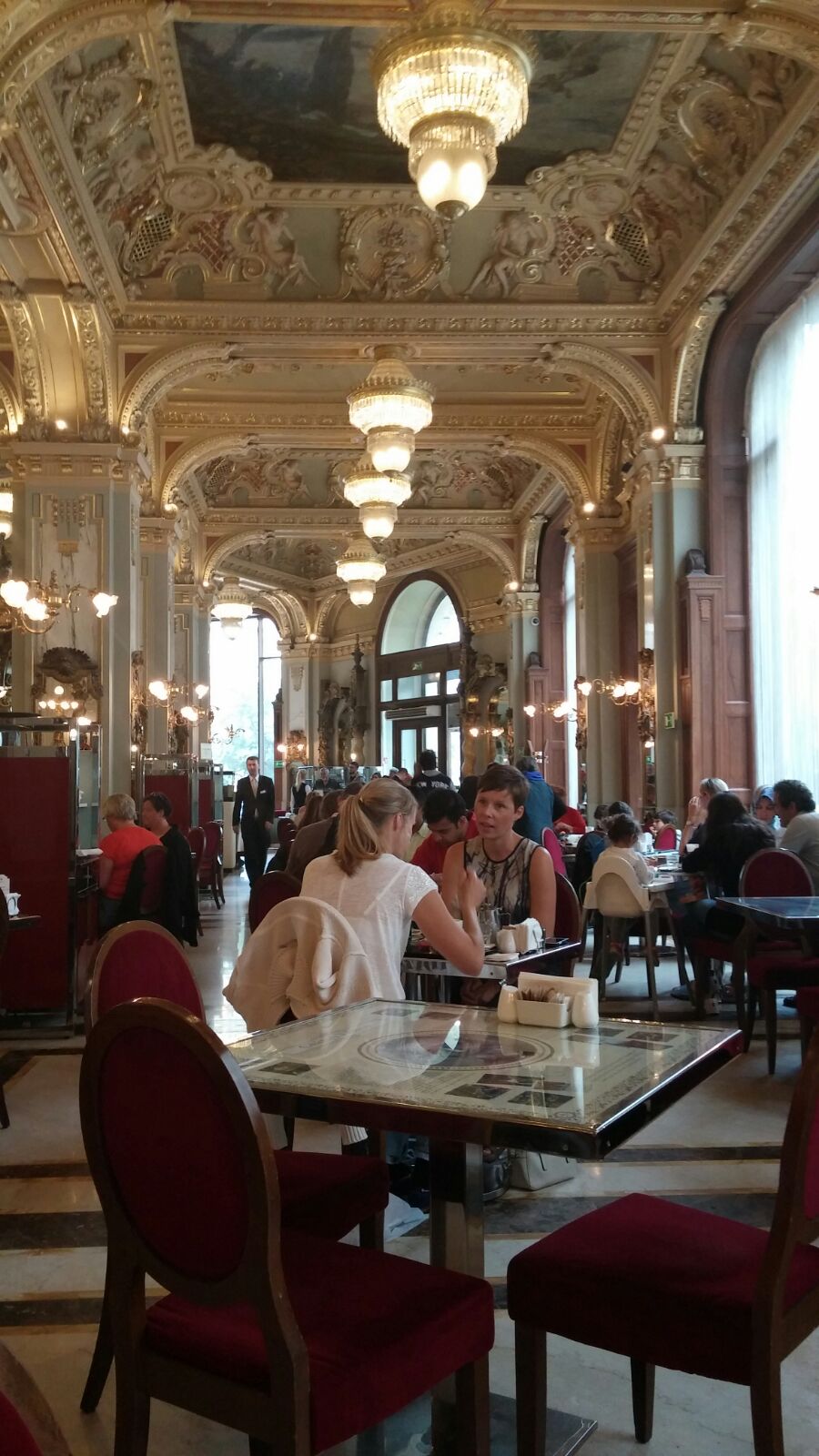
Whilst standing at a traffic light in downtown Budapest today (Sept 6th) , I saw a most shocking site. I was on my way for a coffee at the well known Cafe New York. (New York Kávéház)

It all started with the honking of horns at the Blaha Luzja Ter intersection as cars from all directions applied their brakes. Then there was yelling and screaming and yelping and shouting and the sound of people running or is it a stampede? What is making so much noise?

And right into the intersection they ran , limped and hobbled….thousands of women and children and men and infants with absolutely nothing….I looked in their eyes and saw hell. I gasped for breath and my eyes filled with tears.  

Across Blaha junction they streamed as the locals looked on with anger, fear, disgust or compassion and detachment. 

It was too much: the juxtaposed reality of civilized Budapest, thousands of Syrian refugees flowing thru right next to Cafe New York and  all this less than a mile from where the Jews of Hungary were deported to Auschwitz or killed and thrown into the Danube. Was that a few decades ago..or yesterday?

It really does not matter how this problem came to be, it is a massive system problem that needs to be addressed. In terms of OD, the refugees are a powerless constituency used as a football which can be kicked around. And indeed this is what is happening.

Coffee and cake at the New York Cafe in Budapest are highly recommended.

 de                                                  New York Cafe, Budapest

Share Button

If you are not enabling cooperation, you are irrelevant

I received this email (shortened and edited) 3 weeks ago.

“Allon,

I found out about you from your irritating but hilarious Gloria satire.

I manage a team of 12 HR people in (name withheld), an Anglo-Dutch-Spanish company with operations in Europe and Japan.

I really want my team to development partnership with their managers, yet several of my staff remind me too much of your Gloria: control, sloganeering and fear of confronting poor managers.

Can you give a talk to my staff (one hour) on what you as an OD consultant consider to be the guiding principles for partnering with management that HR should embrace.

Kindly suggest a time we can talk.

Name withheld”

I gave the talk last evening and in this post, I would like to share my main points .

  • The achievements of “homo sapiens at work” stem from our ability to consciously cooperate, “imagining” a future state to which all work in a degree of unison.
  • Powerful factors drive people to poor cooperation, due to flaws in the present economic model, the impact of IT technology on the art of communication and the superficiality caused by the high speed of business.
  • The essence of mighty challenge all of us in the “people professions” face is the need to foster far more cooperation and lessen the growing alienation (anomie) in the workplace.
  • HR seems to have several tools at its disposal: rewards, recruitment, development processes, guardian of the culture, business partnership.
  • Cooperation however is evasive. Too much use of culture-as-a religion promotes rebellion against religious organizational doctrine. Using rewards may work up till a point, only to become a bargaining process of paying for performance. Recruitment is a crap shoot;  all processes have a human “work around”.
  • Thus, there is no “protocol” to enhance cooperation, only trial, error, common sense, pragmatism, luck, and massive investment in mitigating trust issues between with people, within projects and between teams.
  • One needs to focus solely on the cooperation to the exclusion of almost everything else. If what you do does not build cooperation, you are not being effective.
  • You cannot cook an omelet without breaking eggs. Afraid of confrontation? You chose the wrong career.
  • Be very careful not to overdose on measurement. Data can be used to provide an indication; I suggest  not obsessing about measurement. When we start measuring, we like to be accurate, which leads the measurer to change what we are measuring. The act of measuring often negatively impacts he/she who measures to ignore the all too important abstract.
  • Don’t be afraid to sound irrelevant if you believe you are in the right direction. Don’t cave in and “please”. Persevere.
Share Button

A personal “congratulations” to John Scherer

John Scherer will receive ODN’s Lifeline Achievement Award for 2015.

This blog and my Gloria satiric blog exist because John Scherer pressured me to write. Thank you John.

The most useful critique of my global OD work and my style has come from John. His comments have had context, depth and John’s  intent is to help and support. When he speaks, I listen.

John has boundless energy. He inspires, he innovates and he learns, all the time. John has a heart of gold, a heart bigger than he is. John is a giver.His clients are very lucky.

I am a better consultant for having John as a colleague. I am enriched for having him as a friend.

And he truly deserves the recognition he is getting.

Bravo, Johnny boy, from Gloria and me.


Share Button

How to do OD consulting with a startup (updated 2026)

Doing Organizational Development (OD) in Startups (revised 2026)

This post discusses how to do organizational development (OD) work with startups and their founders. Don’t get too excited—it’s not easy.

At first glance, there seems to be a strong match between the value proposition of OD and the needs of startups.

Startups usually have talented people, flexibility, and a high level of engagement. They also do not yet suffer from the chronic problems that affect older organizations.

OD can provide a development platform—mindsets, concepts, and skills—to support the new technologies and products that startups are creating. In addition, teamwork is a critical success factor in startups.

It sounds like a perfect fit.

However, founders are often not receptive to OD. Ironically, the very qualities that allow someone to become a founder can also prevent them from making proper use of OD.

Founders are driven to break barriers and create innovation. Because of this, they often view “organizational issues” in one of two ways:

  1. Organizational issues are trivial—just “common sense” (usually meaning the founder’s own common sense).

  2. Organizational issues are an opportunity to reinvent human nature: “I will create an organization that changes the way people organize.”

Startups may have great ideas, advanced technologies, and talented people. Founders often develop detailed roadmaps for building their technological solutions. Yet they rarely ask a critical question:

“What kind of organization do we need in order to support these great ideas?”

As a result, the factors that eventually limit a startup’s growth are often organizational—and they are frequently reinforced by the behavior of an overly confident founder.

Founders also tend to react poorly to OD consultants. Not only are some founders arrogant, but many OD practitioners lack the technical understanding needed to gain the founders’ respect.

There is also a generational gap. OD consultants are often much older than startup founders, which can create a “parent–child” dynamic. (For example, I am 76, and many of my clients are in their twenties.)

In the early stages, founders typically appoint an administrative assistant as the first HR manager—along with responsibility for facilities and car rentals. This effectively closes the HR channel for serious organizational work, because the newly empowered administrator often blocks access to the CEO.

Sometimes investors try to solve this problem by placing an OD consultant on the board or attaching OD support as a condition of their investment. This approach can undermine trust between the founder and the consultant—although I have seen a few cases where it worked.

In most startups, OD work truly begins only when the founder steps aside to become CTO and a professional CEO is brought in. The tension between the founder and the new CEO is often the ideal entry point for an OD project.

In fact, about 98% of the work I do with startups begins this way.

Once a project begins, I suggest focusing on several key areas:

  1. Align organizational development with future growth. Build the organization that will be needed six months from now, not just the one that fits today.

  2. Create a dialogue and action plan around scalability. The organization must be able to grow without breaking.

  3. Manage the evolution of the early employees. The company should neither become enslaved to the founding team nor simply push them aside. There are constructive ways to handle this transition.

  4. Develop an ongoing life-cycle dialogue about people, skills, norms, and organizational structure.

Follow me: @AllonShevat

Share Button